
Manual to Automated: Expense Reporting Time Savings
Switching to automated expense reporting saves time, reduces errors, and simplifies workflows. Manual processes are slow, error-prone, and frustrating for employees and finance teams. Automation eliminates tedious data entry, speeds up approvals, and ensures accuracy, saving businesses hours and cutting costs.
Key Takeaways:
- Time Savings: Automation cuts expense report processing time by up to 70%. For instance, companies using SAP Concur reduced processing time by 36%.
- Fewer Errors: Manual reports often have a 20% error rate, costing $52 per correction. Automation reduces errors by 32%.
- Cost Efficiency: Manual reporting costs ~$26 per report, while automation lowers it to ~$7.
- Employee Benefits: Faster reimbursements improve morale and eliminate cash flow issues for employees.
- Scalability: Automation handles growing workloads without adding administrative burden.
Platforms like EasyTripExpenses make automation simple for small teams and startups, offering affordable plans, quick onboarding, and user-friendly tools. Transitioning from manual to automated reporting is a practical way to save time and focus on business growth.
Manual vs Automated Expense Reporting: Time and Cost Savings Comparison
What Are Benefits Of Automated Expense Tracking?
How Automation Saves Time: Key Benefits and Metrics
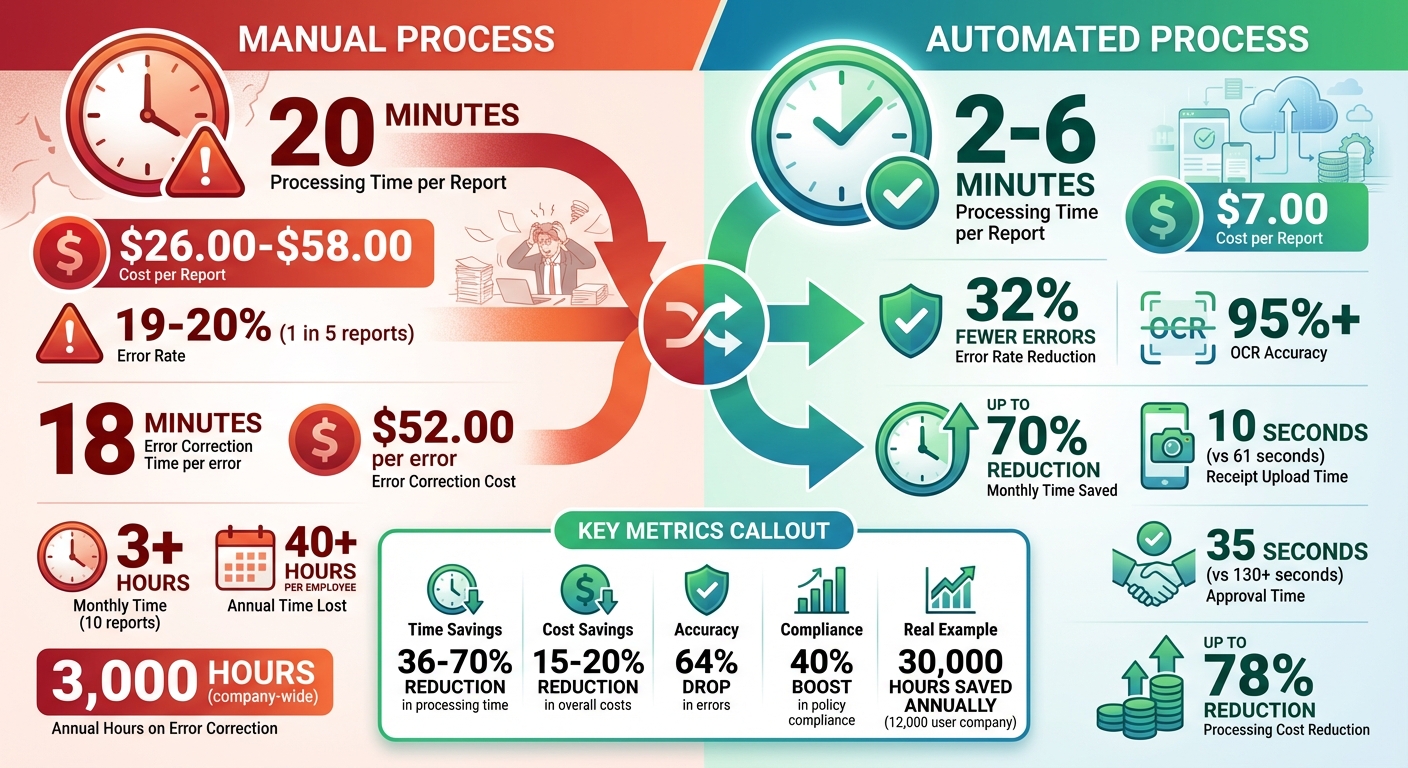
Switching from manual to automated expense reporting isn’t just about convenience - it’s a game-changer for saving time. For instance, in 2021, companies using SAP Concur saw a 36% reduction in expense report processing time. To put this into perspective, a single manual expense report takes around 20 minutes to complete. For an employee submitting 10 reports a month, that’s over 3 hours saved monthly - or roughly 40 hours annually.
The impact becomes even more striking when scaled. According to a 2024 study by Roland Berger, a company with 12,000 users saved 30,000 hours annually by moving from Excel to digital expense software. Tasks that once took minutes, like submitting an expense claim, now take seconds - 10 seconds with advanced software compared to 61 seconds in Excel. Similarly, approval and processing times dropped from over 130 seconds to just 35 seconds, boosting productivity by more than 70%.
One of the biggest advantages here? Automation eliminates the need for repetitive data entry, speeding up processes while ensuring accuracy.
Reducing Manual Data Entry
Gone are the days of typing out receipt details by hand. With advanced automation tools, employees can simply snap a photo of a receipt, and the system uses OCR (Optical Character Recognition) technology to extract the details with over 95% accuracy [7,13]. This not only saves time but also ensures that expenses are categorized correctly within seconds.
Automation also enforces compliance as employees complete their submissions.
"By eliminating the need for manual data entry, employees can submit expenses in seconds." – Emburse
Faster Reconciliation and Reporting
Month-end closing, which used to be a time-consuming ordeal, becomes much faster when expenses are automatically categorized and reports are generated instantly [7,13,15]. Finance teams no longer need to wait for spreadsheets to trickle in. Instead, real-time updates allow for continuous reconciliation, making the process far less overwhelming.
The numbers speak for themselves. A 2024 survey of over 5,000 BILL customers found that the average time to submit an expense report dropped from 23 minutes to just 6 minutes with automation. Processing time per report was slashed from 20 minutes to as little as 2 minutes. Features like customizable approval workflows and one-click approvals further streamline the process, cutting manager review times from hours to mere minutes [7,14].
These time savings don’t just improve efficiency - they also reduce errors, which can be a significant drain on resources.
Fewer Errors and Less Rework
Manual processes are often riddled with mistakes. Nearly 1 in 5 expense reports contain errors, and fixing each one takes an average of 18 minutes, costing companies about $52 per report [12,17]. When you add it all up, businesses spend roughly 3,000 hours annually just correcting expense report errors.
Automation breaks this cycle by handling repetitive tasks with precision. Systems can flag non-compliant or duplicate expenses in real time and match credit card transactions with submitted receipts [7,12,14,16]. This proactive approach catches issues before they escalate, reducing the back-and-forth of rejected reports and resubmissions. Companies that adopt workflow automation experience a 32% reduction in human error, freeing up time for more strategic tasks.
Businesses Saving Time with Automation: Examples
Automation is changing the game for businesses, turning expense reporting from a time-consuming chore into a quick, efficient process.
Small Business Success Stories: From Hours to Minutes
For small businesses and startups, automation has been a game-changer. By cutting processing times by 30–50%, tasks that used to take hours are now completed in minutes. Optical Character Recognition (OCR) technology alone slashes data entry time by more than half. Teams juggling multiple trips each month are reclaiming valuable hours, which they can now dedicate to activities that drive revenue. These time savings also contribute to faster month-end reconciliations, streamlining operations even further.
Case Study: Monthly Reconciliation Improvements
Take month-end reconciliation, for example. What once took days can now be wrapped up in just a few hours, thanks to automation that categorizes expenses in real time. The financial benefits are equally striking: manually handling an expense report costs over $26.00, while an automated process reduces that to just $7.00. For companies processing hundreds of reports each month, the savings in both time and money add up quickly. This streamlined approach not only saves resources but also makes it easier for businesses to scale as they grow.
Scaling Efficiency for Growing Teams
When businesses expand, the volume of expense reports often grows too. Automation ensures that this increase doesn’t translate to a surge in administrative work. Companies automating 65% of their expense reporting see dramatic reductions in processing times, enabling them to handle more transactions without needing to hire additional staff. The benefits are clear: businesses report a 15–20% reduction in costs for automated processes, and cloud-based automation can cut IT expenses by up to 30%. For growing teams, this means they can manage rising demands without the headaches that come with manual systems.
sbb-itb-386cb5b
Why EasyTripExpenses Works for Small Teams and Startups
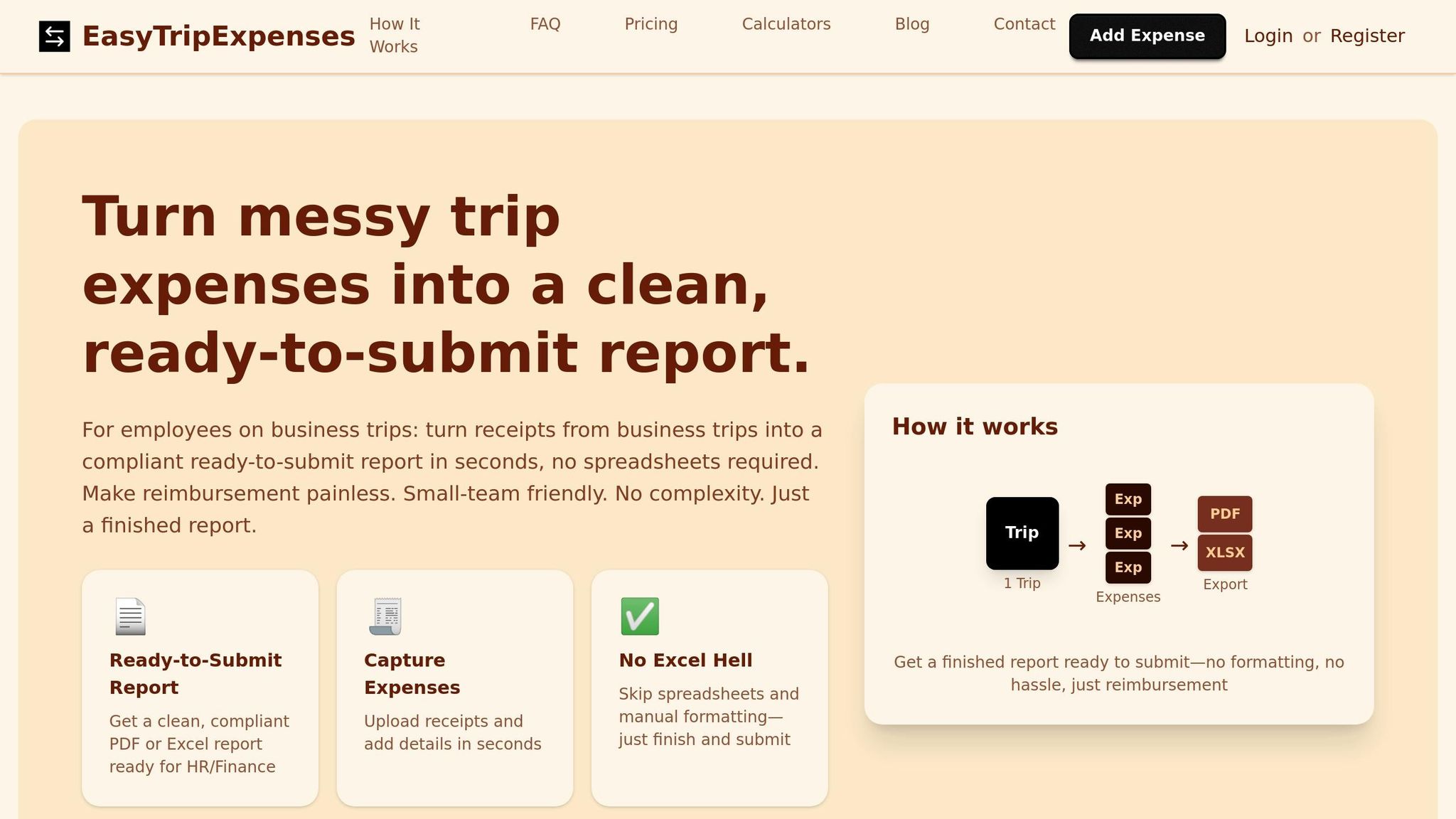
EasyTripExpenses is designed with the needs of agile teams in mind. For small teams and startups, where time and resources are often limited, this platform offers a practical way to turn messy trip expenses into polished, professional reports. It’s a solution that doesn’t just save time - it simplifies the entire process.
Key Features and Benefits
With EasyTripExpenses, managing expenses becomes a breeze. You can upload receipts as images or PDFs, categorize them effortlessly, and generate professional reports in PDF or Excel formats - all through an intuitive web interface. Traveling internationally? The built-in currency conversion tool eliminates the hassle of dealing with exchange rates. Plus, every trip is securely stored in your account history, so you can easily revisit past expenses whenever needed. These features work together to cut down hours of work into just minutes.
Affordable and Scalable Pricing Plans
EasyTripExpenses offers pricing options that cater to different needs:
- Starter Plan: Free forever, allowing up to 5 uploads per trip with 1 active trip at a time. Perfect for occasional travelers or those testing the platform.
- Pro Monthly Plan: Priced at $9.00 per month, this plan increases uploads to 20 per trip and extends trip history to 3 years - ideal for seasonal travel or short-term projects.
- Pro Yearly Plan: At $60.00 per year (just $5.00 per month), this plan offers the best value. It allows 50 uploads per trip and provides 5 years of trip history, making it a great fit for teams with regular travel schedules.
The pricing is not just affordable but also straightforward, ensuring teams can quickly find a plan that suits their needs without overcomplicating the decision-making process.
Quick Onboarding with No IT Setup Required
Getting started with EasyTripExpenses couldn’t be simpler. There’s no need for IT setup or software installation - just sign up, and you’re ready to go. Your team can start uploading receipts and creating expense reports immediately, with no waiting for approvals or dealing with technical hurdles. Even team members who aren’t tech-savvy will find the platform easy to use, making the switch from manual spreadsheets to automated reporting quick and stress-free. It’s a solution built to get you up and running in minutes.
Conclusion: Time Savings Through Automation
Manually handling expense reports eats up both time and money. On average, preparing a manual expense report takes about 20 minutes and costs $58.00. Worse, 19–20% of these reports contain errors, which require an additional 18 minutes and $52.00 to fix. These inefficiencies quickly pile up, creating a significant administrative burden.
Switching to automated expense management drastically reduces these costs and frees up valuable hours for more strategic tasks. Companies that embrace automation report a 64% drop in errors, a 40% boost in policy compliance, and as much as a 78% decrease in processing costs per transaction. For small teams and startups working with limited resources, these gains can make a huge difference - helping them allocate time and money where it matters most.
These benefits aren't just theoretical; they’re backed by real-world success stories. For example, Eduardo Felipez, a Management Accountant at Heroes, slashed five days of manual work each month down to just five hours by automating expense reviews and reconciliations across five entities. This shift has freed up entire workweeks, allowing his team to focus on strategic initiatives instead of drowning in tedious processes.
Platforms like EasyTripExpenses highlight how automation can simplify expense management. With zero IT setup, pricing that starts at $0.00, and a user-friendly interface, it turns time-consuming, manual tasks into quick, manageable ones. Teams can complete what once took hours in just minutes, giving them more time to focus on growing their business.
For small teams and startups aiming to scale efficiently, automation isn’t just helpful - it’s essential. It’s the difference between spending days buried in spreadsheets and dedicating that time to building and expanding your business.
FAQs
How does switching to automated expense reporting benefit employees?
Automated expense reporting takes the hassle out of managing business expenses, making life easier for employees. Gone are the days of tedious manual data entry and the stress of tracking down misplaced receipts. With tools like mobile receipt capture and automatic data population, employees can save time and dodge frustration, freeing them up to focus on work that truly matters.
On top of that, faster processing means quicker reimbursements - an essential way to show respect for employees who cover costs out of their own pocket. This not only eases financial stress but also builds trust. By streamlining approvals and reducing errors, automated systems create a smoother, more supportive workplace experience.
Take EasyTripExpenses, for example. Perfect for small teams and startups, this platform makes expense management a breeze. Employees can upload receipts, categorize expenses automatically, and generate professional reports in just minutes. Plus, it’s all done without the need for complicated IT setups, ensuring reimbursements are fast and stress-free.
How much money can businesses save by automating expense reporting?
Switching to automated expense reporting isn’t just about convenience - it’s a smart financial move. On average, businesses can cut the cost of processing an expense report from over $26 to around $7, saving roughly $19 per report. This adds up to a total cost reduction of 15–20%, allowing companies to manage their budgets more effectively while simplifying the entire expense management process.
How does automation support business growth and scalability?
Automation takes the hassle out of expense reporting, especially for businesses that are growing quickly. By replacing manual tasks with streamlined processes, it saves time and cuts down on errors. Cloud-based systems can handle a high volume of receipts, automatically pull data from them, and enforce company policies instantly. This keeps things running smoothly, even as your team or project count grows.
Modern platforms offer features like flexible approval workflows, budget tracking, and in-depth analytics to meet the unique needs of your business. Tools such as EasyTripExpenses let users upload receipts, allocate costs across multiple projects, and create polished reports - all without needing IT support. This makes it easy for your expense management system to grow right alongside your business.